A Biker Visited My Comatose Daughter Every Day for Six Months – Then I Found Out His Biggest Secret!
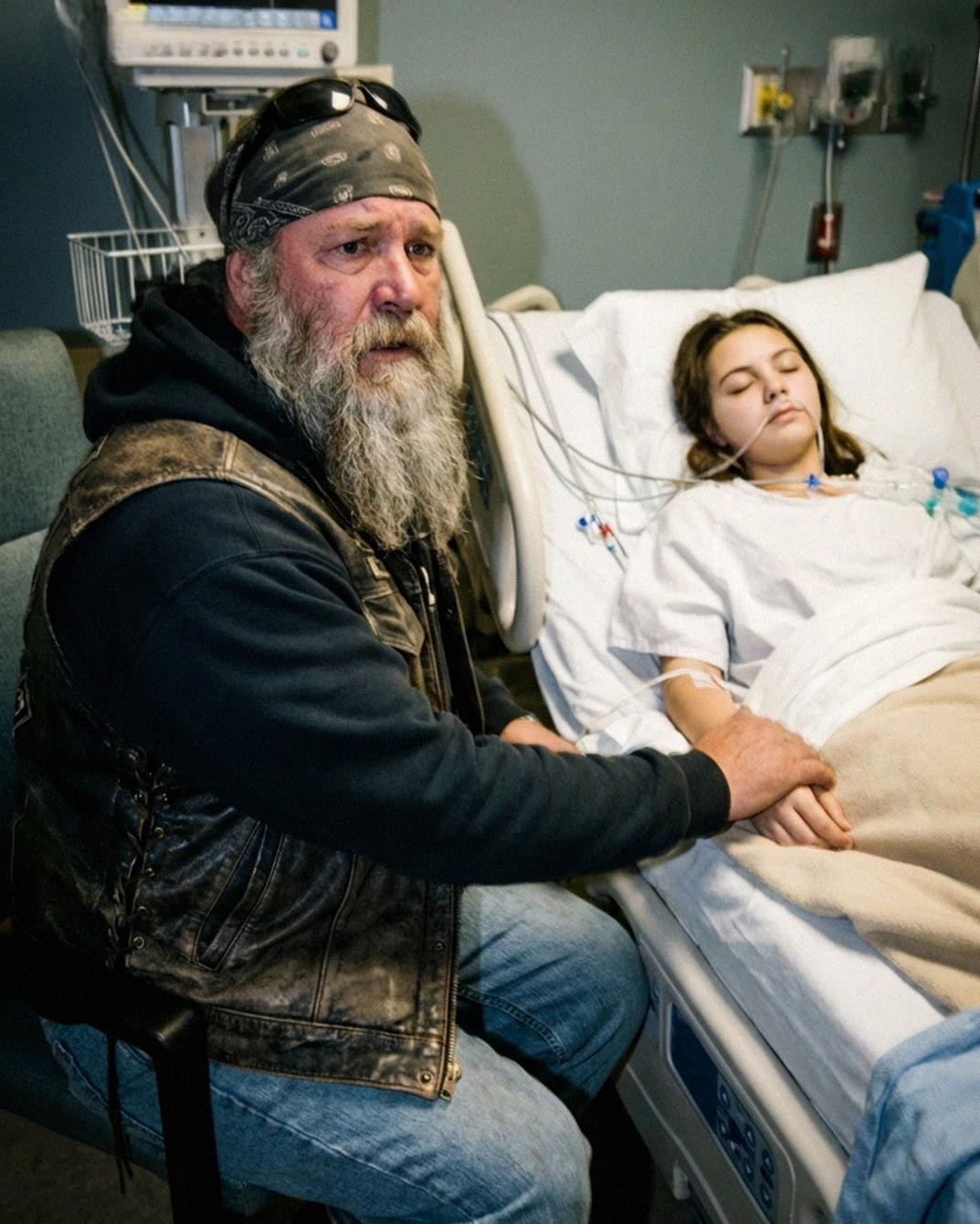
For six straight months, at exactly three o’clock every afternoon, the same man walked into my daughter’s hospital room. He was impossible to miss—tall, broad-shouldered, a gray beard spilling down his chest, leather vest, heavy boots, tattoos curling around scarred hands. He never stayed a minute longer than an hour. He never spoke to me beyond a quiet nod. He held my comatose daughter’s hand, talked to her softly, and then left.
And for far too long, I had no idea who he was.
My name is Sarah. I’m forty-two. My daughter Hannah was seventeen when a drunk driver ran a red light and slammed into her car on the driver’s side, five minutes from our house. She had been driving home from her part-time job at the bookstore, thinking about homework, probably annoyed about something small and ordinary. In seconds, her life stopped.
Now she lay in room 223, surrounded by machines that breathed for her, fed her, monitored her. I lived in that room. I slept in a recliner that never fully closed. I survived on vending machine food. I learned the rhythms of the ICU, the language of beeps, the way time stopped feeling real. Days weren’t measured in hours anymore, just by that clock on the wall.
And every day, at exactly three o’clock, he came.
The nurses greeted him like he belonged there. One of them, Jenna, always offered him coffee. He always accepted politely. He called my daughter by name. Sometimes he read aloud from fantasy novels. Sometimes he just talked, low and steady, like she could hear every word.
Once, I heard him say, “Today sucked, kiddo. But I didn’t drink. So there’s that.”
At four on the dot, he gently placed her hand back on the blanket, nodded to me, and left.
At first, I told myself to be grateful. When your child is in a coma, you don’t reject kindness, even if it’s strange. But months passed, and the questions started clawing at me. He wasn’t family. He wasn’t a friend. None of Hannah’s friends knew him. Her father didn’t know him. Yet there he was, every day, like it was his job to sit with my child.
One afternoon, after he left, I followed him into the hallway.
“Mike?” I said.
He turned. Up close, he looked even larger. But his eyes weren’t hard. They were exhausted.
“I’m Hannah’s mom,” I said.
“I know,” he replied quietly. “You’re Sarah.”
That stopped me cold.
We sat in plastic chairs in the waiting area. My hands were shaking when I finally asked the question I’d been holding for months.
“Who are you,” I said, “and why are you in my daughter’s room?”
He didn’t dodge it.
“I was the drunk driver,” he said. “I hit her.”
The words didn’t land right away. My mind rejected them, like static.
“I pled guilty,” he continued. “Ninety days in jail. Lost my license. Rehab. AA. I haven’t had a drink since that night.”
Rage flooded me so fast it made me dizzy. I told him I should call security. I told him he didn’t deserve to be anywhere near her.
“You’re right,” he said. “You’d be right to throw me out.”
He didn’t defend himself. He didn’t ask for forgiveness. He just sat there like a man already serving a sentence.
He told me he came the day after the crash, just to see if she was real. Not a name in a police report. He told me he picked three o’clock because that was the time of the accident. Every day, at the exact moment he destroyed her life, he sat with the consequence of it.
I told him to stay away.
For the first time in months, three o’clock came and the door didn’t open. I thought I’d feel relief.
Instead, the room felt emptier.
Days passed. I couldn’t sleep. I watched Hannah’s still face and wondered what she would want. Eventually, I went to an AA meeting he had mentioned, sat in the back, and listened as he stood up and said, “I’m Mike, and I’m an alcoholic. I’m also the reason a seventeen-year-old girl is in a coma.”
He didn’t say her name. He didn’t say mine.
Afterward, I told him I didn’t forgive him. I told him he could come back, but only if I was there.
The next day, he hovered in the doorway like a guest afraid to overstay. I nodded once. He came in.
Weeks passed. Then one afternoon, while he was reading, Hannah squeezed my hand. Not a twitch. A squeeze.
The room exploded into motion. Nurses ran in. Doctors followed. Hannah opened her eyes and whispered, “Mom?”
She recognized his voice before she knew the truth.
Later, when she was stronger, we told her everything. She listened, quiet and still.
“I don’t forgive you,” she told him.
“I understand,” he said.
“But don’t disappear,” she added.
Recovery was brutal. Pain. Physical therapy. Nights full of nightmares. He never pushed. He just showed up. Sat quietly. Read when she asked. Left when she was tired.
Almost a year later, Hannah walked out of the hospital with a cane. She took my arm. Then, after a pause, she took his.
“You ruined my life,” she told him.
“I know,” he said.
“And you helped keep me from giving up on it,” she said. “Both can be true.”
Now she’s back at the bookstore part-time. Starting community college. She still limps. She still has bad days.
Every year, at exactly three o’clock on the anniversary of the crash, the three of us meet for coffee. We don’t make speeches. We don’t pretend.
It isn’t forgiveness.
It isn’t forgetting.
It’s choosing to keep living without lying about what happened.