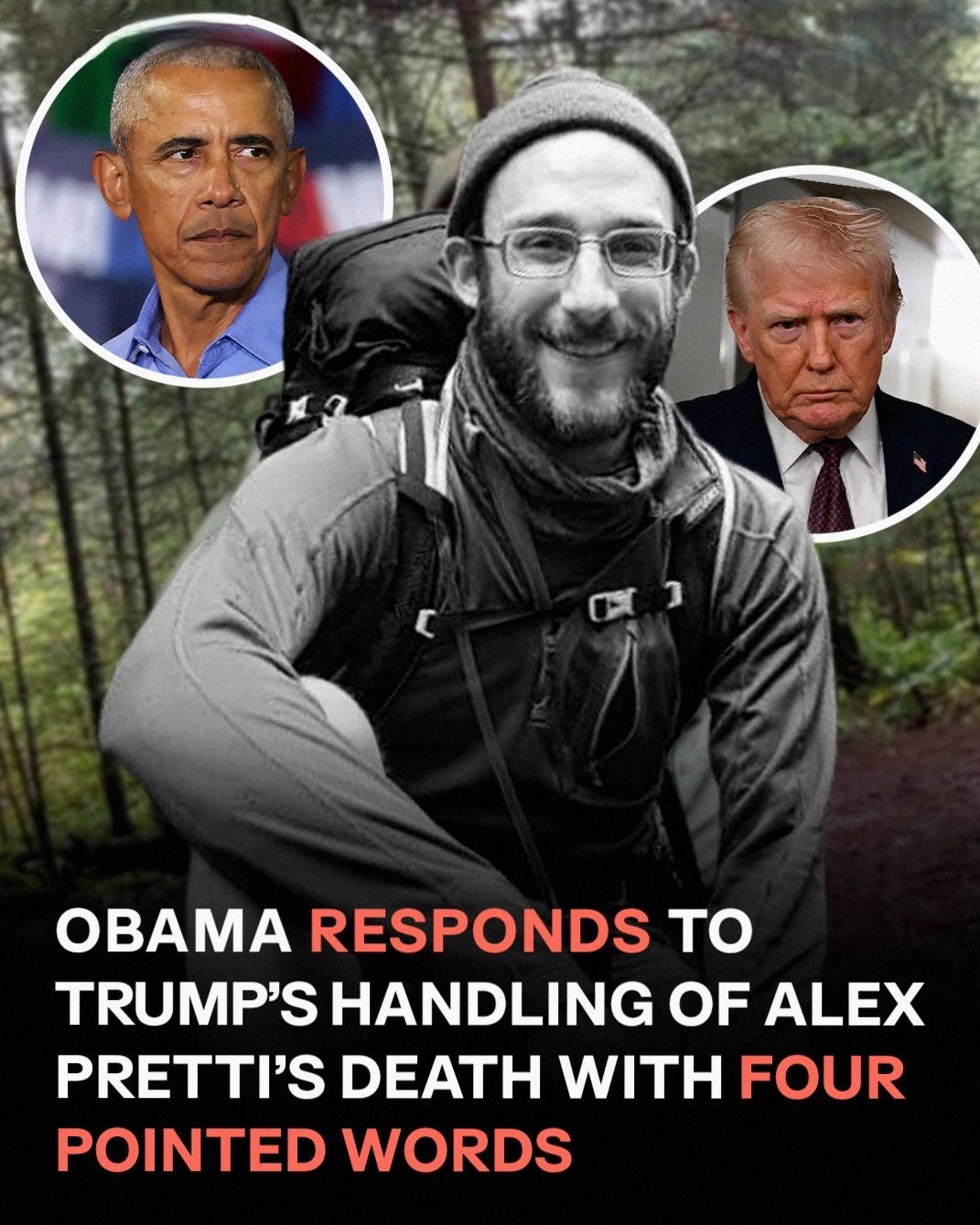
Barack Obama Breaks Silence with Fierce Critique of Trump After Alex Pretti Tragedy in Minneapolis
Former President Barack Obama has issued a rare, pointed statement following the death of Alex Pretti, a 37-year-old Minneapolis ICU nurse and military veteran who was fatally shot during a confrontation with federal agents. Obama’s remarks, released January 25, 2026, frame the killing as more than a single incident, arguing it reflects a dangerous breakdown in accountability and restraint in federal law enforcement operations.
In his statement, Obama called the shooting “a heartbreaking tragedy” and warned that the country’s core values are increasingly “under assault,” urging Americans across political lines to treat what happened as a wake-up call. It was one of his most direct public criticisms of a sitting president since leaving office, and his comments placed responsibility not only on individual actors but on the broader approach and messaging coming from the Trump administration.
https://googleads.g.doubleclick.net/pagead/ads?gdpr=0&client=ca-pub-6638610645332968&output=html&h=280&adk=3343016698&adf=3318573824&pi=t.aa~a.23905774~i.1~rp.4&w=780&fwrn=4&fwrnh=100&lmt=1769699855&rafmt=1&armr=3&sem=mc&pwprc=3462236420&ad_type=text_image&format=780×280&url=https%3A%2F%2Fmardinolay.com%2Fbarack-obama-breaks-silence-with-fierce-critique-of-trump-after-alex-pretti-tragedy-in-minneapolis%2F&fwr=0&pra=3&rh=195&rw=780&rpe=1&resp_fmts=3&aieuf=1&aicrs=1&fa=27&uach=WyJXaW5kb3dzIiwiMTkuMC4wIiwieDg2IiwiIiwiMTQ0LjAuNzU1OS4xMTAiLG51bGwsMCxudWxsLCI2NCIsW1siTm90KEE6QnJhbmQiLCI4LjAuMC4wIl0sWyJDaHJvbWl1bSIsIjE0NC4wLjc1NTkuMTEwIl0sWyJHb29nbGUgQ2hyb21lIiwiMTQ0LjAuNzU1OS4xMTAiXV0sMF0.&abgtt=6&dt=1769699855520&bpp=1&bdt=589&idt=-M&shv=r20260127&mjsv=m202601260101&ptt=9&saldr=aa&abxe=1&cookie=ID%3D139daadf293e7d97%3AT%3D1769631060%3ART%3D1769699580%3AS%3DALNI_MYlqNQU0uCwiFa-_VR6LjVjpHhW2w&gpic=UID%3D00001306c15bb6ee%3AT%3D1769631060%3ART%3D1769699580%3AS%3DALNI_MbJ6qDpb4bosCbAW0P2Cyb8u9xYxw&eo_id_str=ID%3D807feeb7131bbc1c%3AT%3D1769631060%3ART%3D1769699580%3AS%3DAA-AfjZEmTDeW0bFcRa50cXeYyre&prev_fmts=0x0%2C1200x280&nras=3&correlator=3859191597631&frm=20&pv=1&u_tz=60&u_his=2&u_h=1080&u_w=1920&u_ah=1032&u_aw=1920&u_cd=24&u_sd=1&dmc=8&adx=368&ady=1727&biw=1905&bih=945&scr_x=0&scr_y=0&eid=95378425%2C95381971%2C95372614&oid=2&pvsid=975799953836528&tmod=1755361730&uas=3&nvt=1&ref=https%3A%2F%2Fmardinolay.com%2F%3Fs%3DBarack%2BObama%2BBreaks%2BSilence%2Bwith%2BFierce%2BCritique%2Bof%2BTrump%2BAfter%2BAlex%2BPretti%2BTragedy%2Bin%2BMinneapolis%26fbclid%3DIwY2xjawPoWVxleHRuA2FlbQIxMABicmlkETFVY1IxU1BRbGE1QWRiOTBRc3J0YwZhcHBfaWQQMjIyMDM5MTc4ODIwMDg5MgABHsdKboLMi1_EiyiG6zz_u-k3II1fioT3-uFLPwtXTnHx-x979em6WYtTskdc_aem_Cxwnb8qb8j9GXC31JhCouw&fc=1408&brdim=0%2C0%2C0%2C0%2C1920%2C0%2C1920%2C1032%2C1920%2C945&vis=1&rsz=%7C%7Cs%7C&abl=NS&fu=128&bc=31&plas=308x742_l%7C366x742_r&bz=1&pgls=CAEQARoFNC45LjM.~CAEaAzYuOQ..~CAEQBBoHMS4xNzEuMA..&num_ads=1&ifi=3&uci=a!3&btvi=1&fsb=1&dtd=142
Obama’s critique centered on what he described as an aggressive federal posture that has escalated tensions and increased the risk of preventable deaths. He argued that administration officials appeared “eager to escalate the situation,” referring to unrest that has followed the fatal shooting of both Pretti and Renee Good in recent weeks. In Obama’s view, the pattern is not simply about isolated errors, but about tactics, rhetoric, and a willingness to defend questionable actions before any serious investigation can establish the facts.
He accused federal agents of deploying “unprecedented tactics” that, he said, have been used to intimidate and harass citizens rather than protect public safety. In recent weeks, anger has grown after videos circulated online showing masked ICE recruits and other federal personnel conducting operations that critics say feel more like military-style intimidation than law enforcement. Obama echoed those concerns, calling the conduct “embarrassing, lawless and cruel,” repeating language previously used by a former top Department of Homeland Security lawyer who had condemned similar practices.
Obama also took aim at official explanations offered in the immediate aftermath of the shootings. He said the public narrative around the deaths of Pretti and Good appeared to be issued without meaningful investigative grounding and, in some cases, seemed to be contradicted by available footage. Without directly declaring guilt, he warned against rushing to justify lethal force through statements designed to shape public perception before evidence can be properly assessed.
Alongside condemnation, Obama made a plea aimed at de-escalation. He urged federal officials to work constructively with Minnesota Governor Tim Walz, Minneapolis Mayor Jacob Frey, and local law enforcement, arguing that coordination and transparency are essential to preventing additional violence. “This has to stop,” he said, warning that if officials fail to change course, more American lives could be put at risk in a climate already strained by fear, anger, and mistrust.
He ended by voicing support for peaceful protest, calling public demonstrations a “timely reminder” that citizens can demand accountability and challenge abuses of power. At the same time, he emphasized that protest must remain nonviolent, warning that chaos only deepens division and makes it easier for authorities to avoid scrutiny.
While Obama’s statement amplified the political and national dimension of the controversy, the most emotional and personal accounts have come from Pretti’s family, who released their first public statement after his death. They described themselves as “heartbroken and angry,” and condemned what they believe is a coordinated effort to misrepresent who Alex was and what happened in his final moments.
In blunt language, the family accused the administration of spreading “sickening lies” about their son, rejecting depictions of him as a dangerous threat. Their statement insisted that available video shows he was not holding a gun when he was attacked, and they described him as attempting to protect a woman during the confrontation. Their account, as they presented it, stands in direct conflict with official claims that force was used in response to an imminent danger.
According to the family, Pretti was present during an ICE operation in Minneapolis and became involved when officers shoved a woman to the ground. They say footage shows him holding a phone in his right hand, with his left hand empty and raised, appearing to shield the woman or signal non-aggression. They allege that he was pepper-sprayed, forcibly separated from the woman, and then restrained by multiple agents.
The family’s description of the video depicts a frightening escalation: Pretti reportedly struggling on the ground under the weight of several officers while an agent reached toward a holstered firearm. Moments later, the family says, gunfire erupted and killed him. Their statement paints his final actions as consistent with the kind of person they say he was—someone who stepped toward danger to help someone else, not someone who went looking to harm anyone.
Federal authorities, including DHS, have offered a different narrative. Officials have said Pretti was armed with a 9mm handgun and have framed the shooting as self-defense. The family disputes that interpretation and argues that the footage undermines the claim that he posed an immediate, lethal threat at the moment he was shot. They contend that if he had been legally carrying, it still does not justify lethal force if his weapon remained holstered and he was not actively threatening anyone.
Beyond the dispute over the moment of the shooting, the family’s statement focused on who Pretti was when cameras weren’t rolling. They described him as a devoted son, friend, and public servant, emphasizing his work caring for veterans as an ICU nurse at the Minneapolis VA hospital. They said he cared deeply about his community and believed in protecting people who were vulnerable.
They also pushed back hard against attempts to smear him after his death, insisting that the language used by some political figures has been reckless and dehumanizing. In their view, the rush to label him a threat served a political purpose: to justify a harsh federal response and discourage public sympathy. They asked the public to share what they believe is the truth of the incident and to judge their son by his life, not by statements made in the heat of a political crisis.
As public outrage continues and officials promise reviews, Pretti’s death has become a flashpoint in a wider national argument over the scope of federal enforcement power, the boundaries of acceptable force, and the damage done when government messaging appears designed to win the narrative before establishing the facts. Between the former president’s unusually sharp condemnation and the family’s raw grief and anger, the case is no longer only about one man’s death. It has become a test of whether accountability will be demanded, whether evidence will be treated seriously, and whether leaders will choose transparency over escalation in a country already pushed to its emotional edge.