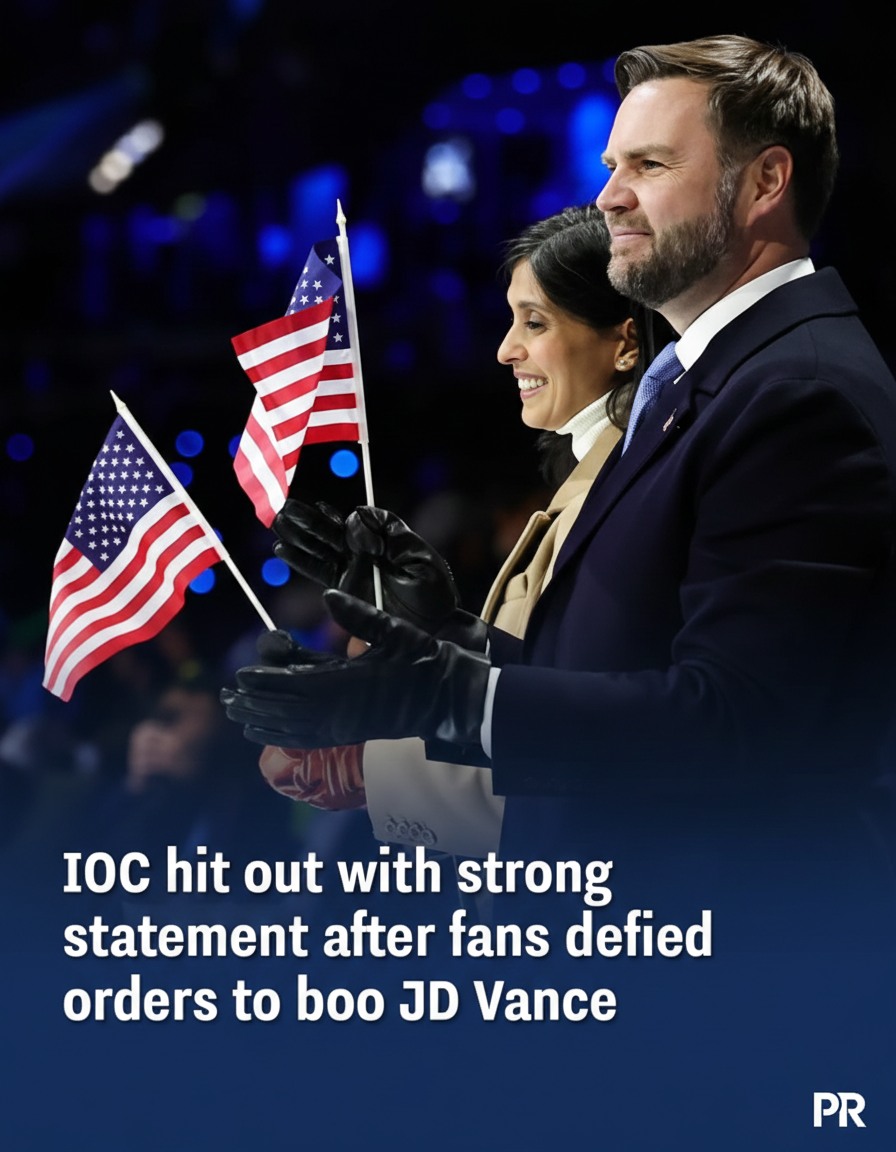
IOC Hit Out With Strong Statement After Fans Defied Orders to Boo JD Vance
The International Olympic Committee moved quickly to address public reaction after JD Vance was loudly booed during the opening ceremony of the 2026 Winter Olympics.
Discover more
The moment unfolded at San Siro Stadium in Milan, as millions of viewers around the world watched a ceremony designed to celebrate unity, athletic excellence, and global cooperation.
What was intended as a shared moment of celebration briefly reflected deeper political tensions.
A Ceremony Framed by Grandeur
The opening ceremony featured high-profile performances by Andrea Bocelli and Mariah Carey, setting a tone of elegance and emotional resonance.
With ninety-two nations participating, the evening highlighted the scale and diversity of the Games. The United States delegation, led by Vice President Vance, entered the stadium amid widespread attention.
When cameras focused on him, sections of the crowd responded with sustained boos.
A Charged Political Atmosphere
The reaction occurred against a tense backdrop.
Earlier that day, large demonstrations took place in Milan in connection with U.S. immigration policies, despite Donald Trump not attending the event. The protests appeared to shape the atmosphere surrounding the ceremony.
Though the Olympics are intended to rise above political divisions, global events and public sentiment often accompany them into the stadium.
Calls for Respect and Restraint
Prior to the ceremony, IOC President Kirsty Coventry had urged participants and spectators to treat the opening as a moment of mutual respect. She expressed hope that political tensions would not overshadow the athletes’ achievements.
Following the incident, IOC spokesperson Mark Adams addressed the situation publicly. He emphasized the organization’s commitment to strong engagement with U.S. leadership, particularly with the upcoming Los Angeles Summer Games, framing cooperation as beneficial for the Olympic movement.
Adams also reaffirmed the IOC’s broader position on crowd behavior, including past incidents involving Israeli athletes. He stressed that competitors should never be targeted for the actions of governments.
“The Olympics,” he noted, “rest on respect, fairness, and appreciation of excellence—regardless of nationality.”
Athletes Between Politics and Purpose
The episode highlighted a recurring tension in global sport.
Athletes train for years to represent skill, discipline, and perseverance. Yet on international stages, they often become symbolic carriers of political meaning they did not choose.
Moments like this reveal how easily public frustration can be projected onto individuals whose primary purpose is competition, not governance.
A Deeper Reflection
The Olympics exist within the world, not outside it.
They reflect its conflicts.
They echo its frustrations.
They carry its hopes.
Yet they also offer something rare: a space where rivalry can coexist with respect, and difference can exist without dehumanization.
Preserving that space requires restraint—from institutions, leaders, and spectators alike.
Conclusion
The IOC’s response to the reaction toward Vice President Vance emphasized its long-standing commitment to neutrality, dignity, and athlete protection.
While political tensions briefly surfaced during the ceremony, the organization reaffirmed that the heart of the Olympic movement lies in unity through sport.
In a divided global climate, such moments serve as reminders that true international cooperation is not achieved by ignoring differences—but by choosing, again and again, to place respect above reaction.
And in doing so, to let athletic excellence speak louder than politics.