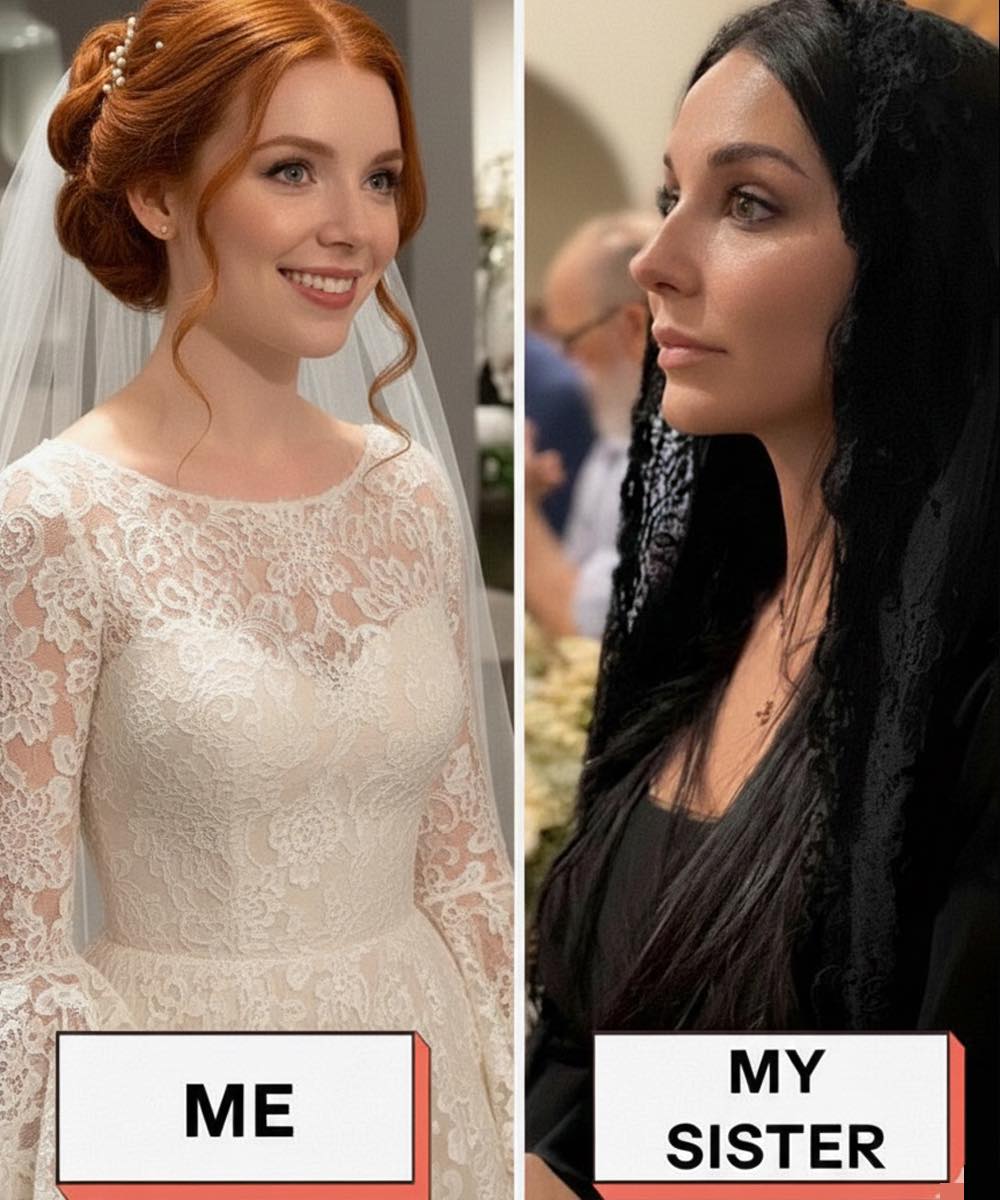
My Sister Wore a Mourning Dress to My Wedding – Therefore I Taught Her a Lesson She’ll Never Forget
I thought I had designed the perfect wedding—one so carefully built that nothing could possibly crack it. After years of effort, sacrifice, and relentless planning, I truly believed the joy of that day was untouchable. I was wrong. One selfish decision by someone closest to me turned what should have been a pure celebration into an unforgettable confrontation.
I didn’t prepare for my wedding casually. This wasn’t about flipping through magazines in spare moments or pinning inspiration photos late at night. This was full-scale planning—the kind that quietly takes over your entire life.
Most evenings ended with spreadsheets glowing on my laptop while my fiancé, Mark, sat across from me at the kitchen table, rubbing his temples and squinting at numbers.
“If we shift this cost here,” he’d ask, “does it still balance?”
We had budget discussions that left me staring at the ceiling afterward, wondering how anyone ever managed to pay for a wedding at all. Weekends disappeared into long drives between venues, sitting on folding chairs, nodding as coordinators explained contracts, deposits, and policies we barely understood.
“I just want it to feel right,” I kept saying.
“And not ruin us financially,” Mark would add—half joking, half serious.
Nothing in our lives had ever come easily. We both worked full-time jobs and grew up in families where money was discussed quietly, behind closed doors, with a mixture of caution and stress. We knew what it felt like to want something badly and be told it wasn’t realistic.
So we made a pact early on: if we were going to do this, we would do it properly.
That meant saving—real saving. No trips. No spontaneous nights out. We skipped vacations while friends posted beach photos and sunset cocktails. We turned down invitations with excuses that grew thinner every time.
“Next time,” we kept telling people. We said “no” far more often than “yes,” even when it hurt.
When we finally secured the countryside venue—with its wide lawn, towering oak trees, and a quiet pool tucked behind the guest house—I sat in the car afterward and cried.
Mark reached over and squeezed my hand.
“We did it,” he said softly.
“It finally feels real,” I told him, laughing through tears. “Like we earned this.”
We sent our save-the-dates nearly a year ahead of time. I remember standing at the kitchen counter sorting envelopes while Mark read names aloud.
“They’re going to love this place,” he said.
“I just want everyone to be there,” I replied.
The responses were warm. Messages poured in. Calls followed. Plans were made. It felt like momentum—like everything was finally aligning.
Everyone was excited.
Everyone except my sister.
Louisa had always been difficult. Two years younger than me, strikingly beautiful, and deeply convinced the world owed her something extra simply for existing. Growing up, she demanded attention loudly and unapologetically.
If I was praised, she wanted more.
“Well, I did that too,” she’d say.
If I achieved something quietly, she redirected the focus back to herself.
“Did you hear what happened to me today?”
I learned early that peace with Louisa usually meant giving in.
“Just let her have it,” my mother would whisper. “It’s easier.”
So when Louisa finally called—nearly a year after receiving the save-the-date—I should have known it wouldn’t be simple. She had said nothing for twelve months, then chose the last possible moment to erupt.
When her name lit up my phone, I remember thinking, Please, just say congratulations.
Instead, the second I answered, she screamed.
“What?!” she shouted—before I could even say hello.
I froze, phone pressed to my ear.
“I’m supposed to have my wedding this month! How could you do this?!”
“What wedding, Louisa?” I asked carefully. “You’ve never mentioned getting married.”
She scoffed.
“Because you never listen to me.”
There was no ring. No fiancé. For years, she had openly mocked marriage, calling it outdated and pointless.
“You always said you didn’t even want to get married,” I reminded her.
“That doesn’t mean I don’t deserve it,” she snapped. “You’re trying to overshadow me.”
“There’s room for both of us,” I said. “We can celebrate two weddings.”
“No! You’re stealing my day! You’re a horrible sister!”
She hung up.
After that came silence. I texted. Then texted again. No response. Eventually, I accepted she might not come at all—and convinced myself that was probably for the best.
It still hurt, but I refused to let Louisa derail what we’d worked so hard to build.
On the wedding day, everything felt perfect. The sun was warm, the air smelled like grass and summer flowers, and for once, nothing went wrong.
Friends helped me get ready. My mother cried three times before noon. Mark sent me a note that made me laugh so hard I nearly ruined my makeup.
The venue looked exactly as I’d imagined. The cake stood near the lawn—white, elegant, flawless.
I stepped outside in my dress, ready for the cake cutting.
That’s when I saw her.
Louisa stood beside the cake wearing a black mourning dress, a dark veil covering her face. She looked like she was attending a funeral, not her sister’s wedding.
My stomach dropped.
When she noticed me staring, she smiled.
The ceremony itself had been flawless. Walking down the aisle, I felt untouchable. When Mark and I kissed, applause washed over us like a wave.
The reception began beautifully—laughter, speeches, clinking glasses.
Then Louisa flipped the cake.
Time froze. Frosting hit the grass. Someone screamed.
“What are you doing?!” I shouted, running toward her.
She stepped back, hands raised.
“What? It was an accident. The cake was uneven.”
Staff rushed in. Guests whispered. Mark, not yet understanding the intent behind it, called for help.
Shock gave way to clarity.
I went to the room where I’d gotten dressed and pulled open the drawer I’d prepared—just in case.
Minutes later, I returned.
The guests fell silent as I took the microphone. Louisa’s confidence wavered when she saw the envelope in my hand—our grandmother’s handwriting unmistakable.
Weeks earlier, sensing something darker behind Louisa’s fixation, I had visited Aunt Carol. The truth had come slowly.
Louisa believed our grandmother had promised her a large inheritance—on the condition that she be the first granddaughter to marry. It was a story she’d told herself for years.
Everyone had read the will. There was no such condition.
Still, Louisa believed if she pushed hard enough, reality would bend.
Standing before everyone, I read the clause aloud.
Louisa snapped.
“You’re lying!” she screamed. “You forged that! Grandma promised it to me!”
“She never did,” I said calmly. “We all know that.”
She lost control.
“You were supposed to wait! Everyone was supposed to let me go first!”
Silence settled over the crowd.
Then Aunt Carol stood.
“That’s enough. She’s telling the truth. There was never a promise.”
Louisa looked around, desperate for someone—anyone—to defend her.
No one did.
She turned and walked away.
Later that evening, as Mark and I sat by the pool, feet dangling in the water, he squeezed my hand.
“You did the right thing,” he said.
And for the first time in years, I felt light. Not because the day had gone perfectly—but because the lies that had hovered over my family for so long had finally been dragged into the open, where they could no longer survive.