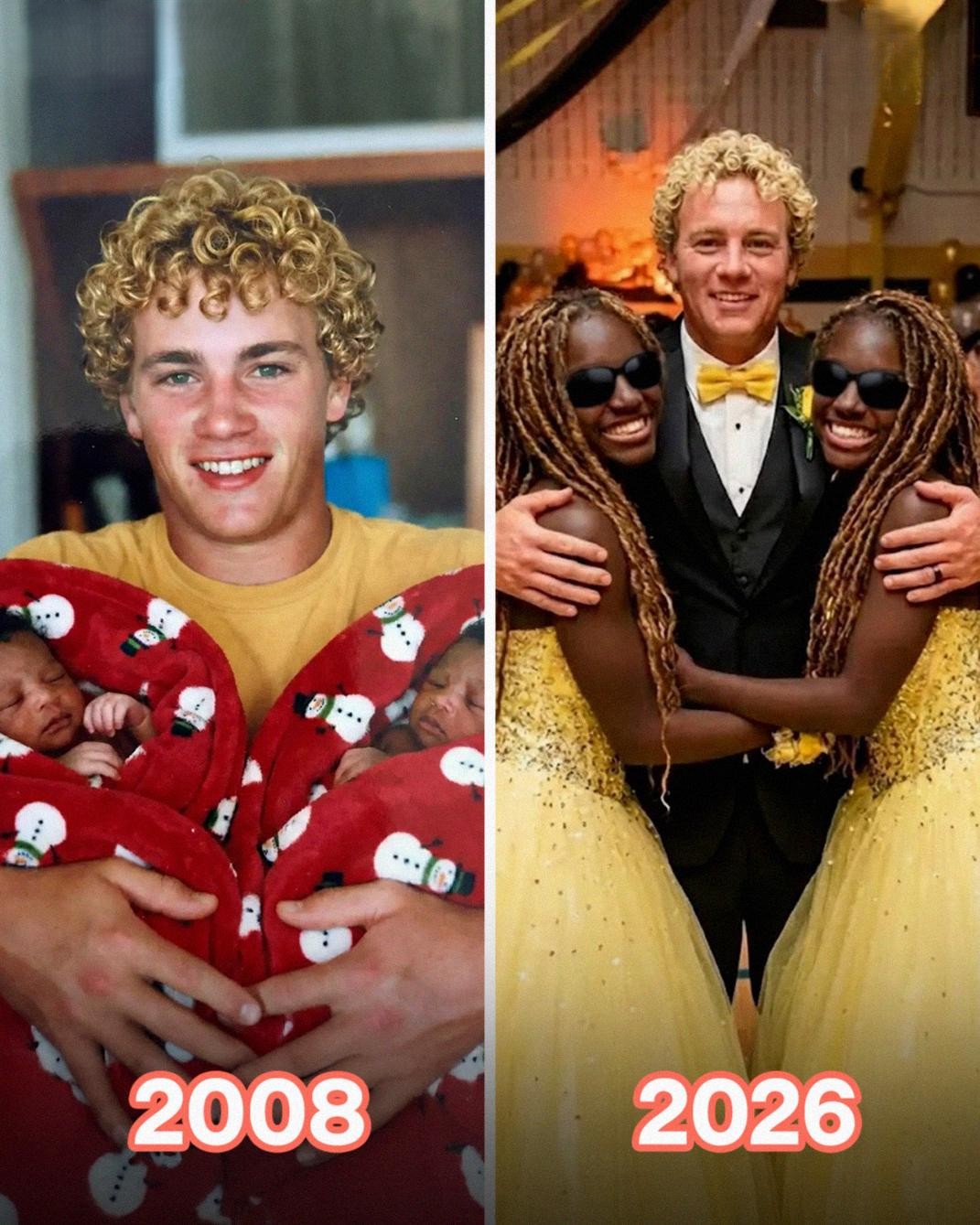
My Wife Abandoned Me with Our Blind Newborn Twins – 18 Years Later, She Returned with One Strict Demand
My name’s Mark. I’m forty-two, and last Thursday brought the kind of knock at the door that makes your whole past stand up inside you.
Eighteen years ago, my wife, Lauren, walked out on me and our newborn twin daughters, Emma and Clara. The girls were born blind, and the doctors delivered that news the way people deliver a storm warning—soft voices, careful eyes, hands folded like prayer.
Lauren didn’t hear “challenge.” She heard “burden.”
Three weeks after we brought the babies home, I woke up to an empty bed and a note on the kitchen counter.
“I can’t do this. I have dreams. I’m sorry.”
That was it. No number. No address. No promise to check in. Just a woman choosing a spotlight over two babies who couldn’t even see their own mother leave.
I didn’t get the luxury of falling apart.
Life turned into bottles at 2 a.m., diapers, laundry, and learning how to raise two blind children in a world that assumes everyone can see. I learned braille before they could even speak. I rearranged the apartment so they could move safely—sharp corners padded, pathways memorized, furniture locked into the same positions like it was bolted to the floor. I learned to listen harder than I’d ever listened in my life, because my daughters were going to experience the world through sound, touch, scent, and patience.
We survived. But I didn’t want survival to be the ceiling.
When the girls were five, I taught them how to sew. It started as therapy—fine motor skills, spatial awareness, keeping their hands busy and their confidence growing. But it became something else, something bigger than I expected.
Emma could run her fingers over fabric and tell you what it was like she had a catalog in her bones—cotton, silk, satin, linen, lace. Clara had an instinct for structure. She could “see” a garment in her mind, the way a musician can hear a song without touching a piano. Together, they turned our living room into a workshop. Fabric piled on chairs. Thread spools lined the windowsill. The sewing machine ran late into the night, that steady hum becoming the heartbeat of our home.
We built a life out of scraps, literally and figuratively.
The girls grew up strong. They learned cane routes like other kids learned shortcuts through backyards. They found friends who didn’t reduce them to a disability. They argued, laughed, dreamed, fought for independence—normal teenage stuff, just with more patience and more courage packed into it.
And they almost never asked about their mother.
Not because they didn’t wonder. Because I made sure her absence didn’t become their wound. I never poisoned them with hate, but I didn’t paint her into a saint either. I told them the truth in a way that didn’t crush them: she left, and it wasn’t their fault.
Last Thursday started like any other. Emma and Clara were working on new pieces at the table—hands moving with that familiar certainty—while I made coffee in the kitchen. Then the doorbell rang.
I wasn’t expecting anyone.
When I opened the door, Lauren stood there like a ghost I’d already buried.
She looked… expensive. Hair perfect. Clothes that probably cost more than our rent. Sunglasses even though the sky was dull and overcast. When she lowered them, her expression didn’t soften.
“Mark,” she said, like my name tasted unpleasant.
I didn’t move. I stayed in the doorway, blocking it with my body and my silence.
She pushed past me anyway, heels clicking against our worn floor as if she wanted the sound to announce her importance. Her eyes swept over the apartment—the sewing table, the fabric stacks, the humble space we’d made into a home. Her nose wrinkled.
“You’re still the same loser,” she said, loud enough for the girls to hear. “Still living in this hole? You’re supposed to be a man—making big money, building an empire.”
My jaw clenched, but I didn’t give her the fight she came looking for.
Emma and Clara had frozen at the table. They couldn’t see her, but they could hear her. That’s something people forget about blind kids—they don’t miss the truth. They hear it.
“Who’s there, Dad?” Clara asked quietly.
I drew a breath I didn’t feel ready for. “It’s your… mother.”
The silence that followed wasn’t awkward. It was surgical.
Lauren walked farther into the room like she owned it.
“Girls!” she said, suddenly syrup-sweet. “Look at you. You’re so grown up.”
Emma’s face stayed calm, but her voice went sharp. “We can’t see, remember? We’re blind. Isn’t that why you left?”
For half a second Lauren faltered. Then she recovered, because she’s the kind of person who treats emotion like a stage cue.
“Of course, sweetheart. I meant… you’ve grown so much. I’ve thought about you every day.”
“Funny,” Clara said, her voice cool as ice. “We haven’t thought about you at all.”
I didn’t tell them to soften it. I didn’t need to. The time for protecting Lauren’s feelings ended eighteen years ago.
Lauren cleared her throat, clearly thrown off by their lack of awe.
“I came for a reason,” she said. “I have something for you.”
She produced two garment bags and laid them neatly on the couch like a display. Then she pulled out a thick envelope—cash, heavy enough to make a dull, confident thud against the cushion. The whole thing felt rehearsed.
“These are designer gowns,” she said, unzipping one bag so expensive fabric slid into view. “The kind you could never afford. And there’s money too—enough to change your lives.”
My daughters’ hands found each other, fingers interlacing tight.
“Why?” I asked. My voice came out rougher than I intended. “Why now? After eighteen years?”
Lauren smiled, but it didn’t touch her eyes. “Because I want my daughters back. I want to give them the life they deserve.”
Then she placed a folded document on top of the cash.
“But there’s one condition.”
The room felt smaller.
“What condition?” Emma asked, her voice steady but careful.
Lauren’s smile widened like she enjoyed this part. “You can have all of it. The gowns, the money, everything. But you have to choose me over your father.”
The words sat in the air like poison.
“You have to acknowledge publicly that he failed you,” she added, voice rising with the confidence of someone who thinks money can buy truth. “That he kept you in poverty while I was out building a better future. That you’re choosing to live with me because I can actually provide for you.”
My hands tightened into fists at my sides. “You’re out of your mind.”
“Am I?” she snapped back, turning her triumph on me. “I’m offering them opportunity. What have you given them? A cramped apartment and sewing lessons?”
Emma reached toward the document, fingers hovering uncertainly. “Dad… what does it say?”
I took it, and my chest burned as I read. It was exactly what Lauren promised—a contract demanding Emma and Clara denounce me as inadequate, credit Lauren as the reason for their “real future,” and essentially sign my role in their lives into the trash.
“She wants you to trade me for money,” I said quietly, and my voice cracked anyway. “That’s what this is.”
Clara’s face went pale. “That’s… sick.”
“That’s business,” Lauren corrected. “Decide now.”
Emma picked up the envelope of cash, feeling its weight. For a second, my heart broke open in fear—not because I believed she’d choose Lauren, but because I knew how heavy money feels when you’ve lived without it. How tempting it can sound when you’ve had to earn everything twice.
“This is a lot,” Emma said softly.
My throat tightened. “Emma…”
“Let me finish, Dad.”
She turned toward Lauren’s voice.
“This is a lot of money,” Emma continued. “Probably more than we’ve ever had at once.”
Lauren’s smugness returned like a spotlight flipping on.
“But here’s the funny thing,” Emma said, her voice growing stronger. “We’ve never needed it. We’ve had everything that actually matters.”
Clara stood beside her sister, shoulders squared. “We had a father who stayed. Who learned braille. Who moved furniture so we wouldn’t get hurt. Who taught us skills so we wouldn’t be helpless.”
Emma nodded. “A dad who made sure we never felt broken.”
Lauren’s breathing changed. The confidence started to crack.
“We don’t want your money,” Clara said, precise and firm. “We don’t want your gowns. And we don’t want you.”
Emma lifted the envelope and tore it open.
Bills fluttered out into the air, floating down like confetti—soft paper rain landing on the floor, on the sewing machine pedal, on the edge of the table… and on Lauren’s expensive shoes.
“You can keep it,” Emma said. “We’re not for sale.”
Lauren’s composure shattered like glass.
“You ungrateful—!” she shrieked. “Do you know who I am now? I’m famous! I worked for eighteen years to build a career, to make something of myself!”
“For yourself,” I said, finally letting my voice cut through.
“And now you want to use us like a redemption story,” Clara added. “So people clap for the mother who ‘came back.’ We’re not your props.”
Lauren spun toward me, furious. “You kept them in poverty! You turned them into little seamstresses instead of giving them real opportunities! I came back to save them from you!”
“No,” I said, and my voice stayed steady because I’d had eighteen years of practice holding the line. “You came back because you want a storyline. You want the world to think you’re a good mother. You want applause.”
Her silence lasted one heartbeat.
Then she exploded.
“I wanted the world to see I’m a good mother!” she screamed. “That I stayed away because I was building something better!”
“You stayed away because you were selfish,” Emma said, and there was no cruelty in it—just clarity. “That’s the truth.”
Clara walked to the door and opened it. “Please leave.”
Lauren stood there breathing hard, the mask gone. She looked down at the scattered bills, then up toward the daughters who wanted nothing from her, then toward me—the man she thought she could erase.
“You’ll regret this,” she hissed.
“No,” I said. “You will.”
She bent down, scrambling to gather the money with shaking hands, stuffing it back into the envelope as if she could stuff her dignity back in with it. Then she yanked up the garment bags and stormed out.
The door shut behind her with a click that felt like a boundary locking into place.
Later, I found out the whole thing was recorded.
Emma’s best friend had been video-calling from a phone propped on the sewing table, watching the girls work, catching the entire confrontation without meaning to. She posted it with a caption that spread like wildfire:
“This is what real love looks like.”
By the next morning, strangers were in our inbox. Journalists. Commenters. People who wanted to turn our life into content.
We didn’t chase attention. We didn’t need it.
But something good came from it anyway—something real.
A costume design program reached out. Not because they pitied my daughters. Because their work was genuinely exceptional. Because talent doesn’t need eyesight to be real. They offered scholarships. Internships. A path forward based on skill, not sympathy.
Yesterday, I stood on a small set and watched Emma adjust an actress’s collar while Clara pinned a hemline with quick, confident hands. They moved like they belonged there—because they did.
A director came over, smiling. “Your daughters are incredibly talented. We’re lucky to have them.”
“I’m the lucky one,” I said.
Emma sensed me nearby and called out, “Dad, how does it look?”
“Perfect,” I said, and my eyes burned anyway. “Just like you.”
That night, we went back to our same modest apartment—the one Lauren mocked—and ate takeout at the kitchen table while the girls laughed about something silly that happened on set. The sewing machine sat in the corner like it always had. The fabric scraps were still there. The life we built from nothing was still here.
And it hit me, sitting there with them, that the condition Lauren brought wasn’t just cruel—it was revealing.
She thought love was something you could purchase.
She thought motherhood was something you could perform.
She thought a father who stayed was small because he didn’t shine.
But the truth is, the brightest thing in this house was never money.
It was loyalty. It was patience. It was two girls who learned how to build beauty with their hands and their courage. It was the kind of love that doesn’t leave when life gets inconvenient.
And when Lauren tried to buy her way back in, she learned what I learned a long time ago:
There’s a difference between expensive and valuable.
And my daughters already knew exactly which one she was.